
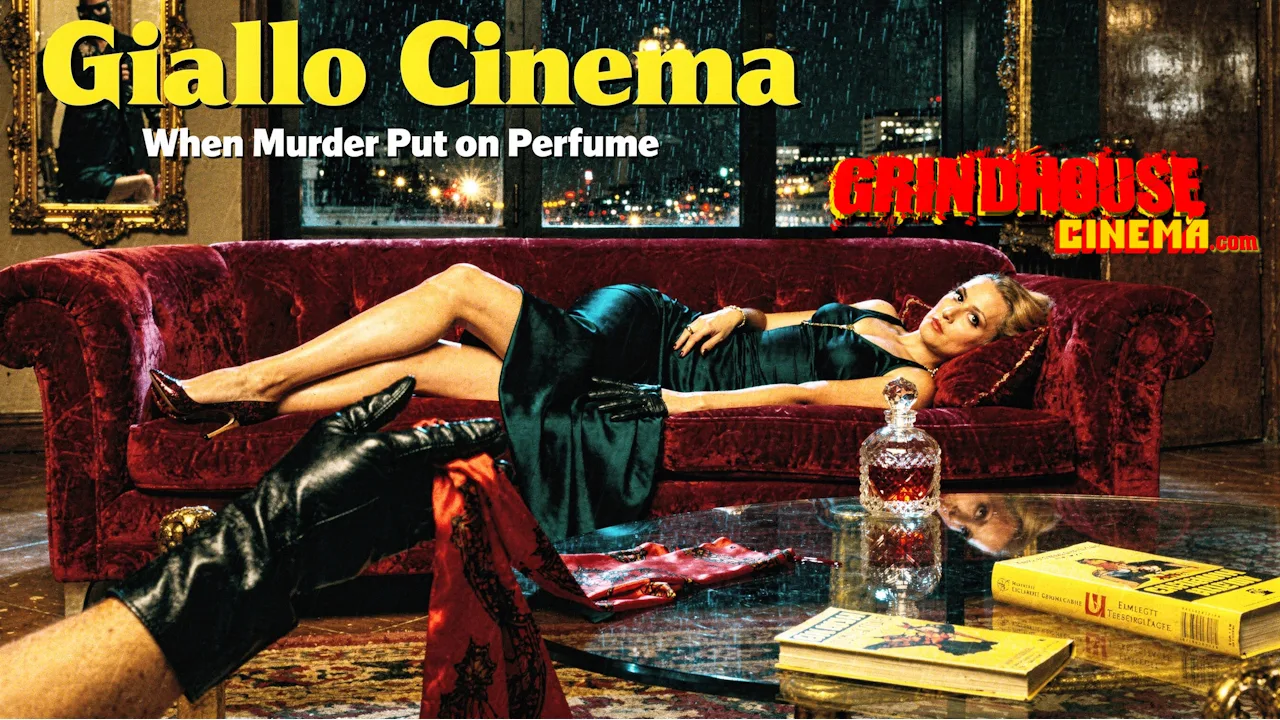
Giallo Cinema: Black Gloves, Beautiful Murders, and the Stylish Madness of Italian Thriller Culture
When Murder Put on Perfume
Some genres announce themselves with monsters.
Giallo arrives with a camera glide, a silk scarf, a locked room, a trembling witness, and a murder staged like a fashion editorial gone catastrophically wrong.
That is the first thing to understand about giallo: it is not just a thriller subgenre. It is a mood, a visual language, and a very Italian way of turning violence, paranoia, sex, and style into cinematic opera.
It is also gloriously excessive.
Giallo films do not simply ask “who is the killer?”
They ask:
- who is watching?
- who is lying?
- why does every apartment look suspiciously elegant?
- and why does danger always seem to arrive wearing leather gloves?
Born from pulp mystery traditions and transformed by Italian filmmakers into something far stranger, giallo became one of the most distinctive forms of 1970s genre cinema. It gave audiences murder mysteries drenched in color, erotic tension, neurotic psychology, and enough atmosphere to make ordinary thrillers look embarrassingly sober.
At its best, giallo is where pulp fiction, modern anxiety, and visual seduction meet.
At its wildest, it feels like someone took an Agatha Christie setup, filtered it through pop art, voyeurism, Catholic guilt, and a nervous breakdown, then added a killer’s-eye-view tracking shot for good measure.
Which is, frankly, why people still love it.
What Does “Giallo” Mean?
The word giallo simply means yellow in Italian, but in film culture it refers to a very specific tradition of mystery-thriller storytelling.
The name came from the yellow-covered crime and mystery paperbacks published in Italy in the early 20th century. Those books created a recognizable market for suspense, murder, secrets, and twist-based storytelling. By the time Italian cinema absorbed those impulses, the result had evolved far beyond a basic detective mystery.
Giallo films became:
- more erotic
- more visual
- more psychological
- more stylized
- and much more interested in sensation than realism
That is the key difference.
A standard thriller wants to solve a murder.
A giallo wants to seduce you, disturb you, mislead you, and make the murder scene look weirdly beautiful on the way there.
The Roots of Giallo: Crime Fiction, Gothic Atmosphere, and Postwar Anxiety
Giallo did not appear from nowhere. It grew out of several converging traditions:
1. Crime and mystery fiction
The genre inherited the whodunit structure, hidden motives, and obsession with clues.
2. Gothic melodrama
Italian cinema had long been comfortable with atmosphere, repression, and decaying moral worlds.
3. Psychological instability
By the late 1960s and early 1970s, thrillers increasingly leaned into trauma, hallucination, memory, and unreliable perception.
4. Modern urban unease
Giallo often feels deeply tied to modernity: city life, alienation, sexual anxiety, media culture, and the sense that contemporary sophistication is just a polished surface covering rot.
This mix is what gives the genre its flavor. Giallo is never only about murder. It is about social surfaces cracking.
The Golden Age: Why the 1970s Belonged to Giallo
The 1970s were the perfect decade for giallo to bloom.
Censorship was looser. Audiences were open to stronger erotic content and more graphic violence. Italian genre cinema was thriving through co-productions, international distribution, and a willingness to move quickly when a style proved marketable.
Giallo thrived in this environment because it offered everything grindhouse and cult audiences wanted:
- danger
- glamour
- sex
- mystery
- visual flair
- shock
- and just enough artfulness to make the whole thing feel elevated rather than disposable
That last part matters.
Even when giallo films are pulpy, they often look and feel richer than ordinary exploitation. They care about:
- lighting
- architecture
- texture
- music
- costume
- camera movement
- visual rhythm
In other words, they understand that murder is a performance.
What Makes a Film Feel Like Giallo?
Not every film with a murder and an Italian poster counts, of course. Giallo has a recognizable anatomy.
Black-gloved killer
Perhaps the most iconic image in the genre. The killer is frequently depersonalized into fetishized fragments: hands, weapons, shoes, breath, a point of view.
Amateur or accidental investigator
Instead of a conventional detective, many gialli follow writers, models, tourists, artists, lovers, journalists, or traumatized witnesses pulled into a mystery they are not equipped to solve.
Murder as spectacle
Deaths are staged with an aesthetic intensity rare in ordinary thrillers. Lighting, framing, color, sound, and timing all matter.
Sexual anxiety
Desire in giallo is rarely stable. It is tied to jealousy, obsession, voyeurism, repression, and danger.
Psychological uncertainty
Memory gaps, hallucinations, childhood trauma, false perceptions, and buried motives are everywhere.
Modern environments with hidden corruption
Apartments, villas, fashion houses, clinics, hotels, and urban streets become zones of unease.
This combination is why giallo feels so seductive. It turns the thriller into a sensual machine.
Giallo and Eroticism: A Very Dangerous Relationship
One of the reasons giallo overlaps so naturally with your Erotic 70s and Sleaze Horror silos is that eroticism is not just incidental to the genre—it is built into its atmosphere.
Bodies matter in giallo. So do glances, clothing, mirrors, windows, and acts of watching.
The genre frequently ties sexuality to:
- vulnerability
- performance
- power imbalance
- guilt
- spectacle
- and threat
This does not mean every giallo is a straight erotic thriller, but the genre almost always understands that tension becomes more powerful when desire and danger occupy the same frame.
That is why titles like Strip Nude for Your Killer (1975) feel so natural inside the tradition. Giallo is not embarrassed by the fact that it wants to thrill and seduce at the same time.
It knows exactly what it is doing.
Giallo vs. Slasher: Cousins, Not Twins
Giallo is often described as a precursor to the slasher film, and that is partly true. You can absolutely see the influence in:
- black-gloved killers
- POV murder shots
- escalating body counts
- isolated victims
- stylized killing set-pieces
But the difference is important.
Slashers usually strip the mystery down and intensify the survival pattern.
Gialli tend to preserve the whodunit structure, the psychological maze, and the eroticized modern setting.
A slasher often asks: can the victim survive?
A giallo asks: who is performing this nightmare, and what buried motive is poisoning the entire world around them?
Slashers run. Gialli glide.
Giallo and Social Decay
For all their style, many gialli are deeply cynical films.
They often reveal:
- class rot
- sexual hypocrisy
- family corruption
- institutional failure
- religious repression
- modern emptiness
The killer is rarely just “evil” in a vacuum. The social world around the murders is often already diseased. Wealth does not protect anyone. Beauty conceals damage. Respectability is unreliable. Adults are compromised. Desire curdles into violence.
This is one reason Don’t Torture a Duckling (1972) remains so powerful. The genre’s most memorable films often use murder mystery as a way of exposing whole communities rather than just individual pathology.
That gives giallo more bite than a simple puzzle thriller.
Why Giallo Feels So Stylish
Because style is not decoration in giallo. It is structure.
The genre depends on visual seduction because viewers are meant to become uncertain about what they are seeing, what they missed, and what emotional tone they are supposed to trust. If a murder scene is beautiful, does that make it more disturbing? If a room is elegant, does that make the threat worse? If a witness is glamorous, are they reliable—or merely part of the spectacle?
Giallo uses beauty to weaken certainty.
This is why the genre can feel almost dreamlike. It does not always behave according to strict realism. It behaves according to heightened anxiety, visual fixation, and unstable memory.
And honestly, that is half the fun. A soberly lit giallo would be like espresso without caffeine: technically present, spiritually wrong.
The Late 70s Drift: Harder Edges, Dirtier Variations
As the 1970s progressed, giallo began bleeding into adjacent territory:
- more explicit erotica
- rougher exploitation energy
- proto-slasher intensity
- nastier violence
- sleazier settings
This mutation phase is extremely important for your site because it creates direct bridges into:
Films in this late cycle may be messier, harsher, or less elegant than the earlier classics, but they also reveal how durable the genre’s DNA was. Giallo did not vanish. It mutated outward, infecting other modes of cult cinema.
Which feels thematically appropriate, really.
Why Giallo Still Matters
Because few genres understand the thrill of cinema itself quite like giallo does.
It knows that audiences do not just want answers. They want:
- atmosphere
- suspicion
- color
- rhythm
- danger
- beauty
- and the delicious feeling that something is wrong long before they can explain why
Giallo matters because it transformed the murder mystery into a sensory event. It fused pulp plotting with visual style so completely that even its imitators and descendants still carry its fingerprints.
It also matters because it is one of the clearest examples of cult cinema’s great truth:
A genre can be lurid, excessive, even ridiculous at times—and still be artistically vital.
Or perhaps more accurately: sometimes the excess is the vitality.
That is why giallo remains essential. Not as a footnote to horror or thriller history, but as one of the most distinctive cinematic languages the 1970s ever produced.
Essential Giallo Films
- Black Belly of the Tarantula (1971) — One of the clearest early-70s examples of the genre’s sleek murder-mystery machinery: black gloves, erotic unease, and elegant paranoia all working in harmony.
- The Case of the Bloody Iris (1972) — A stylish and vicious apartment-block mystery where sex, suspicion, and spectacle turn modern living into a neon-lit death trap.
- Strip Nude for Your Killer (1975) — Pure late-giallo sleaze energy: fashion-world surface, blackmail, voyeurism, and murder staged with shameless flair.
- Torso (1973) — A major bridge between giallo and proto-slasher cinema, tightening the genre’s erotic tension into something nastier and more survival-driven.
- Don’t Torture a Duckling (1972) — One of the genre’s great masterpieces, using murder mystery to expose repression, hypocrisy, and moral panic in a deeply sick community.
- Death Steps in the Dark (1977) — A strong later entry where psychological uncertainty and stylish violence keep the genre’s machinery running beautifully.
- Hitch-Hike (1977) — More road-terror exploitation than pure classical giallo, but an important adjacent piece showing how the genre’s paranoia and cruelty spread into rougher late-70s territory.
- A Bay of Blood (1971) — A foundational murder web of greed, betrayal, and stylish carnage. Not “pure” giallo in every sense, but absolutely central to the broader Italian thriller-horror bloodstream.
- Night of the Damned (1971) — A more gothic and eerie variant, showing how close giallo could sit beside supernatural unease without losing its sensual mystery feel.
- The Reincarnation of Isabel (1973) — A dreamier, more psychologically unstable entry where identity, obsession, and memory distort the mystery into something almost trance-like.
- Raptus (1969) — An early and more art-leaning edge of the giallo-adjacent field, where psychological fragmentation starts overtaking ordinary thriller logic.
- My Sister, My Love (1969) — A pre-70s but crucially transitional title, rich with taboo tension and emotional corruption that feeds directly into later giallo moods.
- Waves of Lust (1975) — A perfect example of erotic Euro-thriller overlap, where jealousy, confinement, desire, and psychological games create a highly unstable atmosphere.
- Beyond Erotica (1974) — A useful crossover title for mapping the genre’s erotic perimeter, where sensuality and thriller energy refuse to stay in separate rooms.
- A.A.A. Masseuse, Good-Looking, Offers Her Services (1972) — A sleazier edge-of-giallo curiosity that shows how quickly the genre’s murder-mystery DNA could mingle with exploitation marketing instincts.