
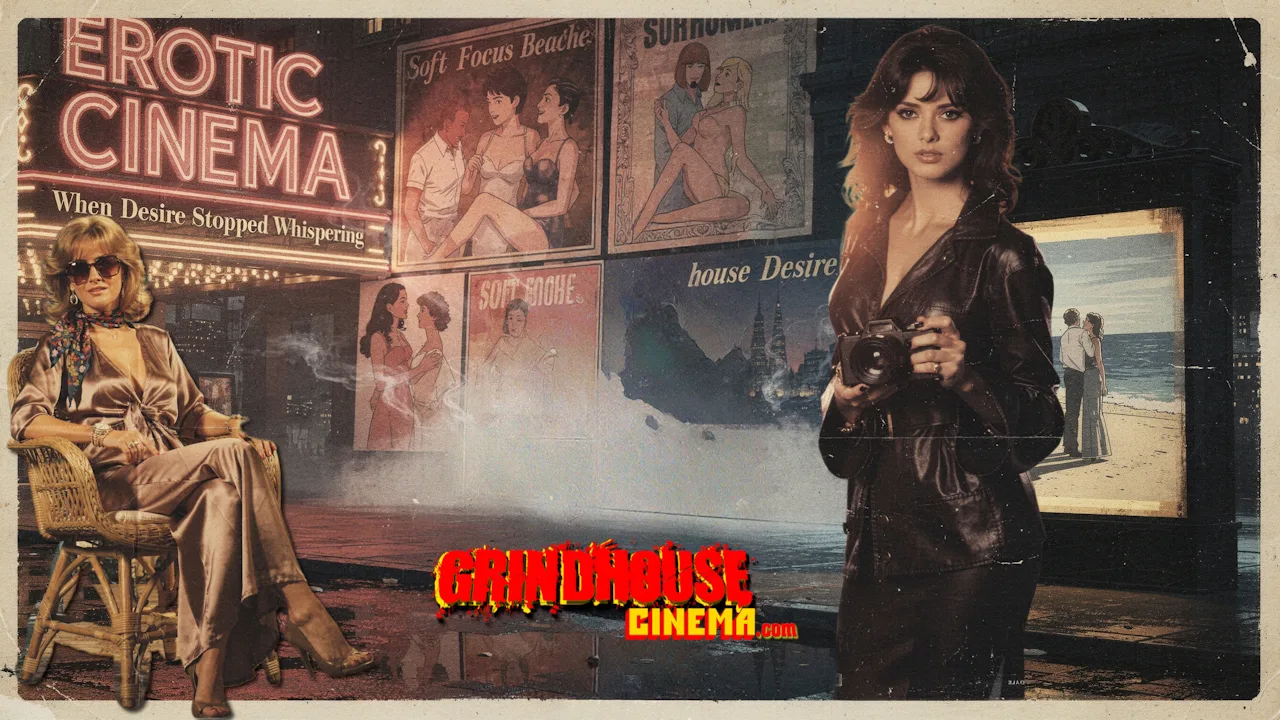
Erotic Cinema in the 1970s: Freedom, Sleaze, Style, and the Golden Age of Eurocult Desire
When Erotic Cinema Stopped Whispering
The 1970s did not invent erotic cinema.
But it absolutely gave it better lighting, stranger energy, looser morals, and a passport.
This was the decade when erotic films stopped hovering timidly at the edge of mainstream culture and started stretching out across grindhouse marquees, European hotel rooms, soft-focus beaches, late-night city streets, and smoky arthouse screens. Desire was no longer something cinema merely hinted at. It became atmosphere. Style. Commodity. Fantasy. Sometimes all before the opening credits had even settled down.
And crucially, 1970s erotic cinema was not one thing.
It was not just romance, and it was not just provocation. It was not always elegant, and it was certainly not always tasteful. Sometimes it was dreamy and melancholy. Sometimes it was crass and shameless. Sometimes it wore the mask of art. Sometimes it kicked the mask down the stairs and charged admission anyway.
That range is exactly what makes the era so important.
The 1970s created a world where erotic cinema could drift between categories: arthouse, exploitation, softcore, Eurocult, psychodrama, sleaze, horror, thriller, and pulp travelogue. It became a meeting point for beauty and bad behavior, liberation and loneliness, sensuality and commerce. One film might sell itself as sophisticated adult drama; another might function like a delirious grindhouse postcard sent from a morally unstable continent.
And honestly, that instability is part of the appeal.
If the 1960s cracked open the door, the 1970s walked in wearing sunglasses, carrying a camera, and pretending not to notice the chaos.
Before the Boom: How the Ground Was Prepared
Erotic cinema did not suddenly appear in 1970 like a champagne cork popping in slow motion. The groundwork had been laid in the previous decade.
The old censorship systems were weakening. Social attitudes were shifting. The so-called sexual revolution had changed what audiences expected from adult storytelling. At the same time, producers and distributors were discovering that there was serious money in films that promised sensuality, scandal, and the faint possibility of seeing something respectable society would rather keep behind closed curtains.
That combination mattered.
Because once censorship loosens, cinema does not become uniformly bold overnight. It becomes experimental, opportunistic, uneven, and commercially curious. Some filmmakers used erotic themes to explore alienation, freedom, identity, or modern relationships. Others looked at the same climate and thought: excellent, we can finally sell this poster.
The 1970s inherited both impulses.
That is why the decade produced erotic cinema at two speeds:
- one drifting toward mood, style, and psychological complexity
- the other racing toward grindhouse sensation, taboo, and marketable transgression
The best films often sit somewhere between them.
Why the 1970s Was the Perfect Decade for Erotic Cinema
The decade itself practically begged for it.
The 1970s were messy, transitional, permissive, and restless. Old codes had weakened, but new certainties had not yet taken their place. That uncertainty gave erotic cinema room to flourish.
Several things came together at once:
1. Censorship weakened
Filmmakers could show more, imply more, and market more directly.
2. International co-productions expanded
European producers could circulate material across borders, combining locations, styles, and market instincts.
3. Grindhouse and adult theaters created demand
There was now an ecosystem for films that did not belong in the family multiplex.
4. Audiences wanted “adult” cinema
And in the 70s, “adult” could mean serious, lurid, chic, or gloriously disreputable depending on the poster and the neighborhood.
5. Genre walls became more porous
Erotic cinema could merge with horror, thrillers, prison films, mystery, travel narratives, and even cannibal films if someone was feeling especially unhinged.
Which, to be fair, was not uncommon.
The Many Faces of 1970s Erotic Cinema
One reason the decade remains fascinating is that erotic cinema did not settle into a single formula. It branched.
The Arthouse-Sensual Strain
These films were often slower, moodier, and more psychologically oriented. Desire was tied to emptiness, alienation, social class, memory, or existential drift. They might still be provocative, but they wanted to be taken seriously.
The Euro-Erotic Jet-Set Strain
This is where glamour enters the room and refuses to leave. Exotic locations, hotel interiors, cosmopolitan nightlife, and emotionally detached protagonists became central. These films sold fantasy through motion: travel, distance, and the suggestion that morality had weaker borders abroad.
The Sleazy Grindhouse Strain
This is where erotic cinema starts rubbing shoulders with exploitation in a more obvious way. Here, atmosphere shares space with marketable shock. Titles get louder. Posters get bolder. Narrative logic becomes negotiable.
The Hybrid Zone
This is arguably the most interesting region of all: films that begin in elegance and drift into pulp, or films that present exploitation with surprising visual sophistication. The 70s loved this unstable territory.
And this is exactly where your site’s brand lives.
Europe Takes the Lead
If America flirted with erotic cinema in the 1970s, Europe committed to the bit.
Italian, French, and Spanish productions especially helped define the decade’s adult visual language. Their films often looked richer, stranger, and more atmospheric than their American counterparts. Even lower-budget efforts could carry an unmistakable Eurocult texture: carefully composed interiors, lush travel imagery, decadent nightlife, uneasy silence, and a sense that everyone on screen knew more than they were saying.
Europe also understood that erotic cinema could be aspirational.
These films often promised more than physical intimacy. They offered:
- luxury
- travel
- mystery
- danger
- boredom disguised as sophistication
- sophistication disguised as boredom
That is part of the appeal. The best Euro erotic films are not merely “about” desire. They are about the worlds built around desire—worlds of money, privilege, instability, secrecy, and drift.
This is why the 1970s European erotic wave still feels so distinctive. It rarely confines itself to straightforward arousal. It wants mood. It wants style. It wants melancholy in the middle of the fantasy.
The Emanuelle Effect
No serious discussion of 1970s erotic cinema works without acknowledging the massive shadow cast by the Emanuelle cycle.
Once films like Black Emanuelle (1975) gained traction, erotic cinema acquired one of its most powerful portable myths. The name became a commercial signal: travel, transgression, sensuality, glamour, and eventual mutation into wilder exploitation territory. It was no longer just a title or a character. It was a usable brand.
And like all strong exploitation brands, it spread.
The Emanuelle wave helped erotic cinema become more internationally coded. It tied sensuality to movement across borders and transformed erotic drift into a recognizable subgenre mood. It also created a bridge between softer erotic atmospheres and much rougher grindhouse material.
In other words, it made erotic cinema easier to market, easier to imitate, and much harder to control.
That usually means a genre has entered its golden age.
Erotica Meets Exploitation
This is where the 70s get especially interesting.
Erotic cinema in this decade frequently collided with adjacent forms:
- sexploitation
- women in prison
- sleazy horror
- giallo
- psychological thrillers
- Naziploitation
- jungle adventure pulp
Sometimes the erotic element was central. Sometimes it was folded into a larger exploitation framework. Sometimes it felt like an arthouse mood piece that had been quietly corrupted by grindhouse instincts.
The result was a cinema of unstable borders.
A film could start as erotic drama and end as institutional nightmare.
A travel fantasy could veer into violence.
A glamour vehicle could mutate into a sleaze engine.
A thriller could become erotic simply through atmosphere, composition, and emotional detachment.
This flexibility made the decade incredibly rich. It also made strict categorization nearly impossible.
Which, for cult film fans, is half the fun.
What “Erotic 70s” Actually Looks Like
The decade developed a very recognizable visual and emotional language.
Soft-focus glamour
Not always literally soft focus, but often close: warm lighting, dreamy interiors, a tactile sense of luxury or faded decadence.
Travel as seduction
Erotic cinema of this era rarely wants to stay home. Desire is tied to distance, hotels, cities, foreign spaces, and the fantasy of elsewhere.
Emotional coolness
Many protagonists do not behave like conventional romantic leads. They drift, observe, detach, and move through unstable social environments.
Decorative danger
Threat is often present, but stylized. The frame remains seductive even when the world inside it starts to rot.
Melancholy under the fantasy
This is the secret ingredient. The best 70s erotic cinema does not just feel sexy. It feels sad, restless, lonely, or morally unmoored.
That emotional undertow is what keeps the best titles from becoming disposable.
The Relationship Between Erotica and Women on Screen
This is where things get complicated—and interesting.
The 1970s erotic wave often promised freedom, but the films themselves do not always agree on what freedom means. Sometimes female protagonists are framed as autonomous, mobile, curious, and socially uncontained. At other times, the films clearly reveal the market logic beneath the fantasy: desire is being packaged, circulated, and sold.
The contradiction is part of the genre.
Some films present women as explorers of unstable worlds. Others treat them as glamorous surfaces moving through male fantasies. Many do both at once. That tension is not a flaw unique to erotic cinema; it is one of the central engines of the entire decade’s cult output.
What matters is that these films often expose their own contradictions.
They promise liberation and reveal loneliness.
They market desire and uncover emptiness.
They fetishize freedom and show how fragile it can be.
That is one reason the decade remains worth revisiting. These films are not morally clean, but they are often culturally revealing.
When Erotic Cinema Turns Darker
Not all 1970s erotic cinema remains in the register of luxury and drift. As the decade advances, some films become rougher, stranger, and more openly exploitative.
This darker turn matters because it expands the subgenre’s reach. Erotic cinema starts bleeding into:
- prison narratives
- taboo cycles
- sadistic authority structures
- late-night sleaze aesthetics
- horror-adjacent textures
At that point, erotic cinema stops being a side category and becomes part of the larger exploitation bloodstream.
This is especially important for a site like yours, because “Erotic 70s” is not an isolated island. It is a major hub that can legitimately connect outward to multiple subgenres without feeling forced. In topical SEO terms, that is gold.
In cult cinema terms, it is even better.
It means the decade’s erotic films are not just sexy curios—they are structural pieces in the architecture of grindhouse culture.
The 1980s Shift: From Erotic Drift to Harder Edges
The early 1980s did not kill 1970s erotic cinema so much as deform it.
As theatrical grindhouse culture weakened and home video became more important, many erotic films lost some of their earlier melancholy and cosmopolitan sheen. What emerged in its place was often harsher, more direct, and less interested in elegance. The mood shifted from jet-set languor to late-night provocation.
That does not mean the 80s material is uninteresting. Far from it.
But the center of gravity changes.
The 1970s remain the golden age because they hold the perfect balance:
- enough censorship collapse to feel transgressive
- enough style consciousness to remain visually distinctive
- enough genre flexibility to produce endless mutations
- enough cultural instability to make the films feel alive
The 80s inherit the shell. The 70s contain the dream.
Why 1970s Erotic Cinema Still Matters
Because it was never just about provocation.
It was about how cinema sold freedom.
How it dressed desire in style.
How it linked sex to travel, melancholy, social drift, and cultural change.
How exploitation learned to look elegant.
And how elegance, sooner or later, learned to get a little dirty.
The best erotic films of the 1970s occupy a remarkable space between commerce and atmosphere. They are seductive but unstable, glamorous but cracked, dreamy but often emotionally cold. They reveal an era trying to enjoy its freedoms while still unsure what those freedoms meant.
That ambiguity is why the decade remains so rich.
And it is why 1970s erotic cinema belongs at the center of any serious grindhouse or Eurocult archive. Not at the margins. Not as guilty filler. At the center.
Because once you understand Erotic 70s cinema, you start understanding how the entire ecosystem around it worked:
- the rise of Eurocult branding
- the spread of sexploitation
- the crossover with prison films and thrillers
- the cult afterlife of stars, cycles, and subgenres
- and the weirdly beautiful fact that some of the sleaziest films of the decade were also among its most atmospheric
A respectable film history might call this contradiction.
A grindhouse fan calls it Tuesday.
Essential Erotic 70s Films
-
Triangle of Lust (1978) — A late-70s erotic psychodrama built around jealousy, desire, and shifting emotional power. Stylish, tense, and soaked in the kind of unstable passion Eurocult handled so well.
-
Violation of Justine (1972) — A darker, more punitive branch of early-70s erotic exploitation, where innocence collides with cruelty and moral collapse. More unsettling than seductive, which is exactly the point.
-
The Roommates (1973) — A compact 70s erotic setup where shared space becomes a pressure cooker for curiosity, temptation, and emotional messiness. Intimate, playful, and quietly provocative.
-
Score (1973) — One of the decade’s most famous adult-era boundary-pushers, balancing camp, sophistication, and sexual experimentation with a distinctly 70s confidence. Daring, talky, and impossible to confuse with anything timid.
-
Terror at Orgy Castle (1971) — A perfect example of erotic horror flirting with gothic absurdity. The title alone tells you subtlety has already left the building.
-
Night Call Nurses (1972) — Part sex comedy, part exploitation snapshot, this one captures the breezier side of early-70s erotic cinema. Playful on the surface, but still very much part of the grindhouse bloodstream.
-
Sugar Cookies (1973) — A glossy and sly blend of eroticism, mystery, and industry satire. Sleek enough to feel upscale, strange enough to stay cult.
-
Thriller: A Cruel Picture (1973) — More revenge nightmare than pure erotica, but essential for understanding how sex, violence, and exploitation fused so explosively in the 70s. Cold, iconic, and absolutely uncompromising.
-
The Fruit Is Ripe (1977) — A later-70s European erotic entry driven by temptation, sensuality, and playful decadence. Light on restraint, heavy on atmosphere.
-
Gas Pump Girls (1979) — A candy-colored late-70s sex comedy with pure drive-in energy. Less melancholy Euro erotica, more playful exploitation party.
-
Naughty Wives (1973) — Domestic respectability gets cheerfully dismantled in this classic adultery-and-curiosity setup. A good example of how 70s erotica loved turning bourgeois order into comic temptation.
-
Images in a Convent (1979) — A major bridge between erotic cinema and nunsploitation, where religious imagery, transgression, and surreal decadence collide. Beautiful, blasphemous, and very late-70s Eurocult.
-
The Big Bird Cage (1972) — Technically Women in Prison territory, but also a strong example of how erotic energy and institutional exploitation overlapped in the 70s. Fast, loud, and gloriously unruly.
-
Schoolgirl Hitchhikers (1973) — Youth, movement, and sexual danger rolled into a classic exploitation road setup. It taps directly into the decade’s fascination with freedom and its consequences.
-
Abigail Lesley Is Back in Town (1975) — A sharp, bitter small-town erotic drama where scandal is less a plot device than a social weapon. More character-driven than many genre cousins, with a distinctly sour aftertaste.