
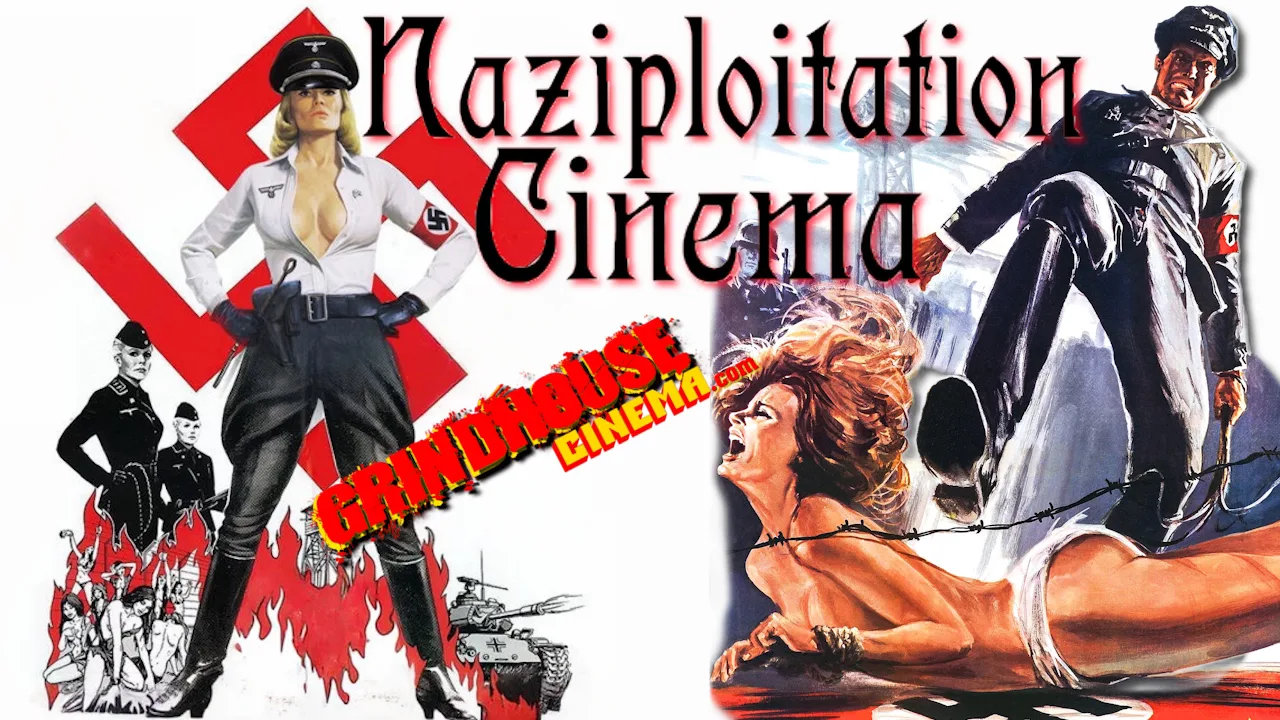
Naziploitation Cinema: Taboo Marketing, Eurocult Excess, and the Darkest Alley of 1970s Exploitation
Naziploitation is the kind of subgenre people rarely “recommend” with a straight face. It’s not a comfortable lane of cult cinema, and it was never meant to be. It exists at the intersection of taboo marketing, shock economics, and Euro-exploitation’s ruthless instinct for turning “the forbidden” into box-office bait.
But here’s the thing: if you’re building a Grindhouse authority site, you don’t become authoritative by pretending the ugliest corners of exploitation history never existed. You become authoritative by explaining why they existed, how they were sold, and what they reveal about the era’s grindhouse ecosystem—without glamorizing the darkness or leaning into graphic sensationalism.
Naziploitation is not “history.”
It’s exploitation cinema using historical imagery as a shock costume—a way to signal danger, transgression, and “banned” energy in a single poster.
In other words: it’s the grindhouse market doing what it always did, just with the most volatile iconography possible.
Where It Came From
The late 1960s and 1970s were a perfect storm:
-
censorship loosening across European markets
-
international co-productions moving fast and cheap
-
grindhouse distributors needing “hook titles”
-
audiences already trained to chase taboo and controversy
-
exploitation cinema building entire campaigns around outrage
Naziploitation emerged as a cynical but effective answer to a commercial question:
“How do we sell a movie as ‘the most extreme thing in the theater’ before anyone even knows what it is?”
The imagery did the selling. The titles did the rest.
What the Subgenre Is (and Isn’t)
Naziploitation is best understood as a marketing-driven Eurocult cycle that borrows:
-
confinement / camp narratives
-
domination and institutional cruelty as exploitation tropes
-
“forbidden” aesthetics to trigger controversy
-
a shock-first mindset typical of 70s grindhouse distribution
It’s not a coherent artistic movement. It’s not a historical statement.
It’s a commercial exploitation lane—one that became infamous precisely because it weaponized the most loaded symbols possible.
Why People Still Study It
Because it reveals exploitation cinema’s purest truth:
-
shock sells
-
outrage is advertising
-
taboo is a shortcut to attention
-
and grindhouse economics often cared more about posters than morality
For collectors, cult historians, and genre scholars, Naziploitation is often discussed as:
-
a case study in exploitation marketing
-
an example of Eurocult’s boundary-pushing business model
-
a controversial “cycle” that shaped late-70s sleaze distribution
-
a bridge into adjacent lanes (women-in-prison riffs, sadistic institution narratives, late-70s shock cinema)
Essential Naziploitation Films
-
Ilsa: She Wolf of the SS (1975) — The most iconic “brand name” of the cycle, and one of the key reasons this subgenre became internationally notorious. Historically essential for understanding how exploitation franchises were built.
-
Love Camp 7 (1969) — An early cornerstone that helped establish the cycle’s commercial template: taboo imagery, confinement setting, and pure grindhouse provocation.
-
Nazi Love Camp 27 (1977) — A peak-era entry from the cycle’s late-70s “boom,” representing how quickly the market multiplied once controversy proved profitable.
-
Gestapo’s Last Orgy (1977) — One of the darkest, most discussed titles in the lane. Historically relevant as an example of how far late-70s Euro-exploitation pushed shock branding.
-
The Red Nights of the Gestapo (1977) — A strong “cycle-era” artifact: lurid title, institutional dread, and the kind of packaging that defined grindhouse controversy marketing.
-
Helltrain (1977) — A transport-themed variation that shows how the cycle kept remixing settings while maintaining its taboo selling points.
-
Deported Women of the SS Special Section (1976) — A mid-cycle title representing the era’s co-production engine: fast output, recognizable iconography, and a direct-to-grindhouse sales pitch.
-
The Beast in Heat (1977) — One of the cycle’s most infamous entries, often cited as a “how extreme did they try to go?” example of late-70s shock cinema economics.
-
Elsa, Fraulein SS (aka Fraulein Kitty) (1977) — A franchise-style title that reflects the cycle’s branding logic: recognizable naming, exploitation packaging, and a market that rewarded provocation.
-
Helga: She Wolf of Spilberg (1977) — Another “wolf” variation showing how quickly the cycle developed repeatable label formulas once one hit caught attention.
-
Private House of the SS (1977) — A late-70s entry emphasizing the cycle’s shift into more claustrophobic, institution-centered exploitation spaces.
-
Devil’s SS (1973) — Earlier-cycle material that demonstrates how the taboo framework existed before the 1977 “rush,” helping map the lane’s evolution.
-
Nathalie: Escape from Hell (1978) — A later entry that carries the cycle’s “confinement + escape” structure, typical of exploitation’s built-in narrative engine.
-
Jailhouse Wardress (1981) — Not strictly within the classic Naziploitation core, but extremely useful as a bridge into your Women-in-Prison and late exploitation ecosystems.
-
Convoy of Girls (1978) — Another cross-bridge title that helps connect your Naziploitation page to broader “transport / captivity” exploitation structures without narrowing the page too tightly.