
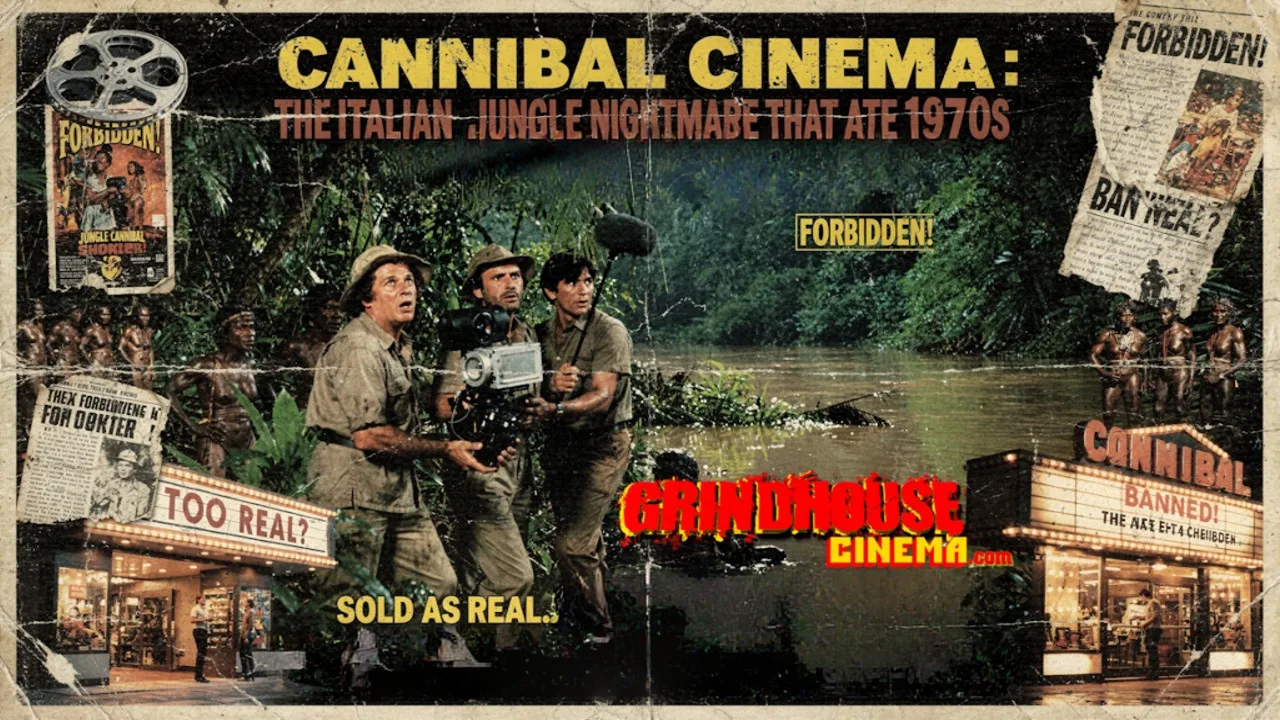
Cannibal Cinema: The Italian Jungle Nightmare That Ate the 1970s (and Kept Chewing in the 80s)
Cannibal cinema is one of those subgenres people don’t “discover” so much as stumble into—usually late at night, usually out of curiosity, and usually with the immediate realization that this is not a genre designed for polite dinner conversation.
But here’s the twist: the cannibal cycle isn’t just shock for shock’s sake. At its peak—especially in the Italian jungle cycle of the late 70s and early 80s—it became a strange collision of travel-adventure fantasy, colonial anxieties, tabloid sensationalism, exploitation economics, and the grindhouse market’s endless hunger for “the next forbidden thing.”
It’s ugly, fascinating, culturally revealing, and unmistakably of its era.
This is the story of how a subgenre turned the jungle into a cinematic nightmare—and why, decades later, people still can’t stop talking about it.
Before the “Cycle”: Where Cannibal Cinema Comes From
Cannibal-themed stories existed long before the Italian exploitation boom. Adventure fiction, colonial travel narratives, and pulp “lost world” stories had been packaging the fear of the unknown for centuries.
What changes in the 1970s is the market:
-
censorship loosens
-
grindhouse and drive-in distribution expands
-
European exploitation becomes more internationally aggressive
-
shock becomes a selling strategy
Cannibal cinema becomes a product that can be marketed as:
-
“forbidden”
-
“dangerous”
-
“too much”
-
“banned”
-
“real”
That last one—“real”—is where the subgenre’s legend (and controversy) grows.
The Italian Jungle Cycle: Why Italy Dominated
Italy didn’t invent cannibal cinema, but Italian exploitation filmmakers perfected the formula—and created the “cycle” as we recognize it.
The Italian cycle thrives because it blends three highly marketable ingredients:
-
Jungle adventure as spectacle
Heat, mud, rivers, remote villages, survival narratives—cinema as travel nightmare. -
Moral inversion as provocation
Many of these films push a blunt theme: the “civilized” outsiders bring greed, cruelty, or corruption into places they claim to be studying, saving, or documenting. -
Marketing as mythology
The posters, taglines, bans, rumors—cannibal cinema was sold like a scandal you could buy a ticket to witness.
This isn’t “nice” cinema. It’s cinema that weaponizes discomfort.
Found-Footage, “Reality,” and the Genre’s Most Dangerous Trick
Cannibal cinema hits its peak myth status when it flirts with documentary aesthetics: handheld footage, staged “reportage,” faux realism, and “we captured something we shouldn’t have.”
Even when viewers know it’s cinema, the presentation is designed to feel unstable—like you’re watching a recovered artifact.
This aesthetic becomes the genre’s most powerful hook:
“What if it looks real enough that your brain stops arguing?”
That’s why the most famous titles in the cycle aren’t just remembered as films—they’re remembered as events.
What Makes a Cannibal Film Feel Like a Cannibal Film?
You can spot the cycle’s DNA pretty quickly:
-
outsiders travel into remote territory (often for research, rescue, profit, or documentation)
-
the environment becomes the antagonist (heat, rivers, isolation)
-
“civilization” is portrayed as morally compromised
-
survival and collapse replace heroism
-
the ending tends to be bleak, cynical, or bitterly ironic
Cannibal cinema often isn’t about “monsters” at all.
It’s about humans behaving like monsters—and then acting surprised by the consequences.
The 1980–1981 Peak: When the Cycle Went Fully Nuclear
If the 1970s built the runway, 1980–1981 is when the cannibal cycle hits maximum cultural explosion: the films become more infamous, more discussed, and more aggressively marketed.
This period also becomes the core of “cannibal discourse” for decades afterward—bans, controversies, debates about exploitation, and the subgenre’s uncomfortable relationship with “authenticity.”
Cannibal Cinema’s Weird Cousins: The Adjacent Jungle and Survival Orbit
Not every jungle exploitation title is a pure cannibal film. But many films orbit the cycle by sharing:
-
jungle adventure DNA
-
exploitation economy
-
survival terror mood
-
colonial travel nightmare framing
These orbit titles matter because they help you build authority around the core cycle, not just inside it.
That’s how you become an authority site: you map the ecosystem, not just the headline.
Why the Cannibal Cycle Still Matters
Because it’s a time capsule of:
-
exploitation-era economics
-
taboo marketing
-
fear of the “unknown” packaged as entertainment
-
moral cynicism about “civilization”
-
and the grindhouse world’s appetite for forbidden cinema
You don’t have to “endorse” the genre to understand its historical importance.
Cannibal cinema is one of the clearest examples of exploitation cinema’s most honest truth:
It sells the viewer a dare—and then dares the viewer to pretend they weren’t curious.
Essential Cannibal Cycle Films
-
Man from Deep River (1972) — Often treated as an early cornerstone of the Italian jungle-cannibal template. Adventure framing, tropical dread, and the first real taste of the cycle’s aesthetic.
-
How Tasty Was My Little Frenchman (1971) — A sharper, more satirical angle on the theme, with a strong “civilization vs. barbarism” irony. Historically important for the way it frames the encounter narrative.
-
Raw Meat (1972) — A gritty early-70s shocker that shows how “extreme” themes were spreading through exploitation cinema well before the cycle’s peak years.
-
Cannibal Girls (1973) — A cult oddball that proves the cannibal idea could mutate into different tonal territories. Less “Italian jungle nightmare,” more grindhouse curiosity with bite.
-
The Mountain of the Cannibal God (1978) — A major late-70s entry where jungle adventure and exploitation intensity collide. The cycle is clearly gearing up for its 1980 blast radius.
-
Cannibal Holocaust (1980) — The “event” film of the cycle: infamous, debated, and foundational to the genre’s mythos. Essential for understanding how realism aesthetics rewired exploitation marketing.
-
Eaten Alive (1980) — A grim, swampy cousin to the Italian jungle wave—heavy on atmosphere and dread, with that “everything is rotting” vibe that exploitation does so well.
-
Cannibal Terror (1980) — A rawer, nastier branch of the boom-year explosion. The kind of title that exists because 1980 was basically the genre’s feeding frenzy.
-
Cannibal Apocalypse (1980) — A mutation of the cannibal idea into a different setting and rhythm—less jungle travelogue, more feverish exploitation paranoia.
-
Night of Death (1980) — A lesser-seen piece in the orbit that helps map how “death jungle” aesthetics spread across exploitation releases around the boom.
-
The Beasts’ Carnival (1980) — Another 1980 entry that reflects how the cycle multiplied rapidly once the market smelled money and controversy.
-
White Cannibal Queen (1980) — A notorious Eurocult jungle exploitation artifact. Historically useful for showing how the cycle commodified “exotic danger” as pure grindhouse branding.
-
Cannibal Ferox (1981) — One of the big follow-up years’ headline titles. A key example of the cycle hardening into its most infamous, market-driven shape.
-
Burial Ground: The Nights of Terror (1981) — Not a pure cannibal film, but essential for the adjacent “Italian nightmare cinema” ecosystem: relentless, nasty, and very much in the same grindhouse bloodstream.
-
Massacre in Dinosaur Valley (1985) — A later-era survival/jungle exploitation echo that shows the cycle’s afterlife. The peak may be over, but the DNA is still there.